


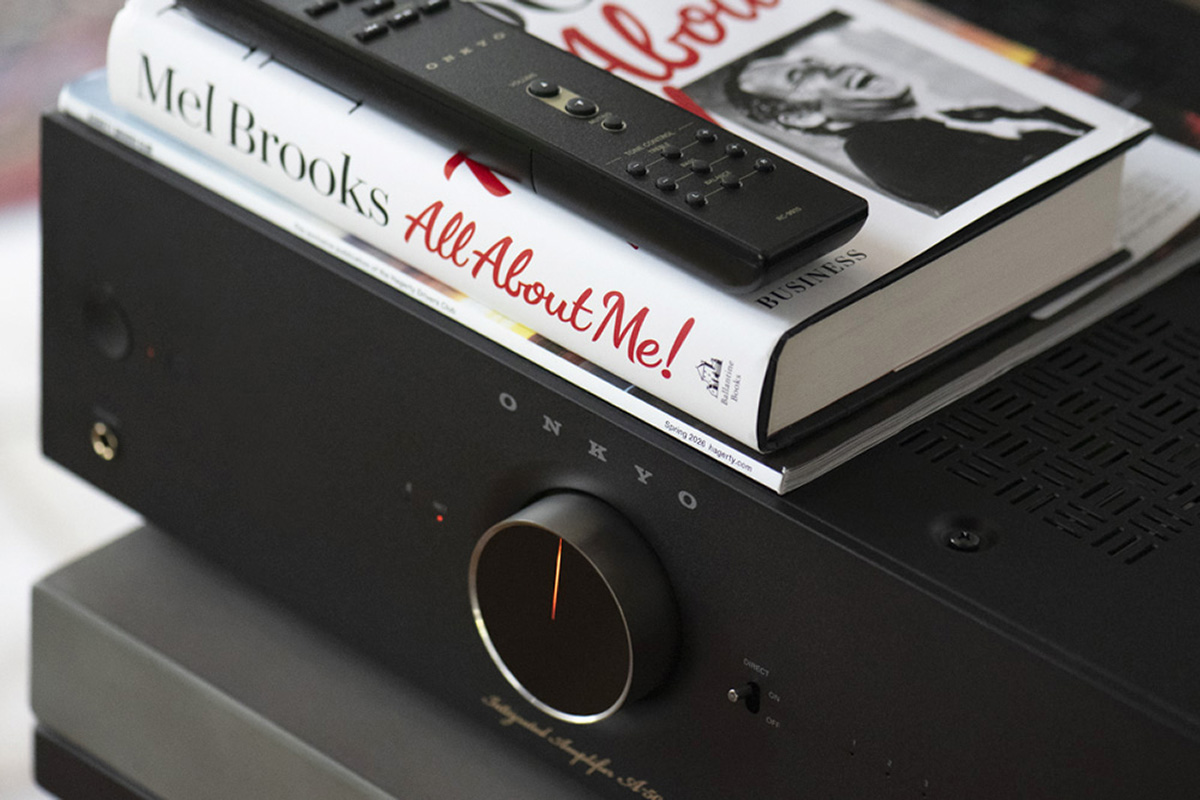
In my recent review of the Onkyo Muse Y‑40 streaming integrated amp (US$999.99, CA$1499, £849, €899) for SoundStage! Access, I said that while there are meaningful technological differences between the company’s Muse and Icon Series offerings, the most significant differences between the two seem to boil down to vibes—at least as far as I could tell, without having dug too deeply into the latter series. Now that I’ve spent a little over a month with the Icon A‑50 (US$1599.99, CA$2599.99, £1199, €1299), I mostly stand by that observation, although the differences under the hood turned out to be a little more substantial than first glances might indicate.
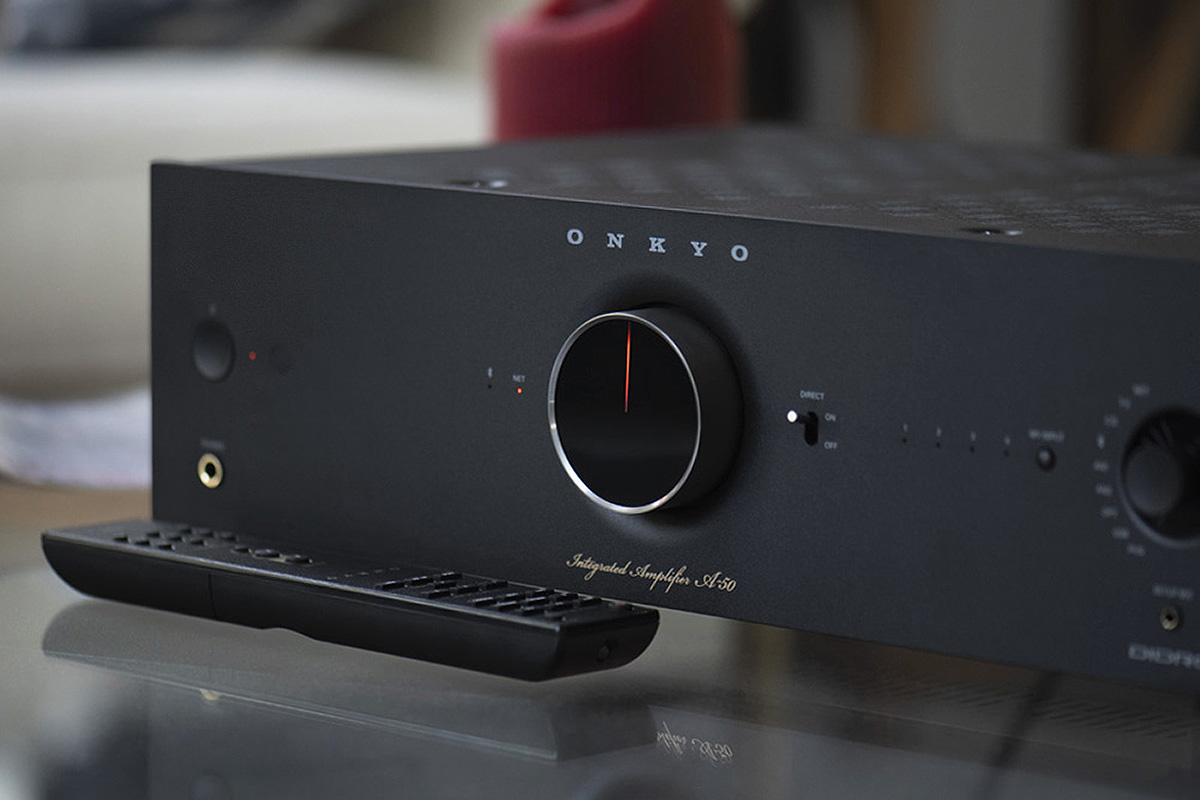
Before we dig beneath the surface, though, let’s start with the vibes, because product photos can’t really give you a sense of the A‑50’s real-life aura. Not even close. How to describe it in evocative terms, though? The allusion my brain immediately reaches for is the old 1980s David Hasselhoff sci‑fi action series Knight Rider. If KITT were a 2020s-era streaming integrated amplifier instead of an erudite ’80s-era artificial intelligence embodied in a third-generation Pontiac Trans Am, he would be the A‑50. I say that because the amp is a charming mix of retro and modern, with little personality traits that are wholly unnecessary but oozing with character.
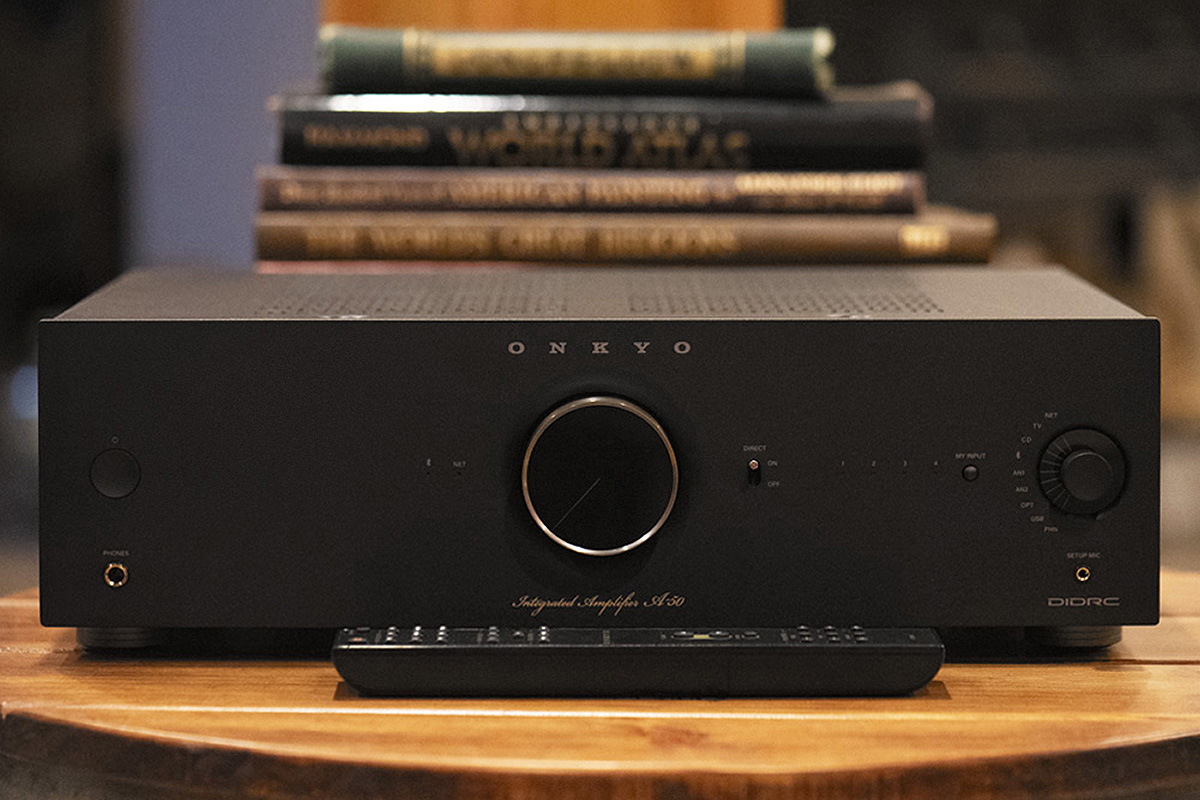
Fire the amp up, and the glowing indicator lines on its powered volume control and source-select knob sweep from their resting positions to the settings that were in place when you last put the amp in standby. It may seem like a weird thing to focus on, but I dig it for a very specific reason: the A‑50 is a connected amp without a screen. Thus, a lot of the visual cues that we associate with a product like this waking up, coming online, and preparing itself for use don’t apply. Those rotating red lines remove some ambiguity, but they do so subtly. They almost subliminally let you know that it’s time to listen to some music. But more than anything, they’re just friggin’ cool.
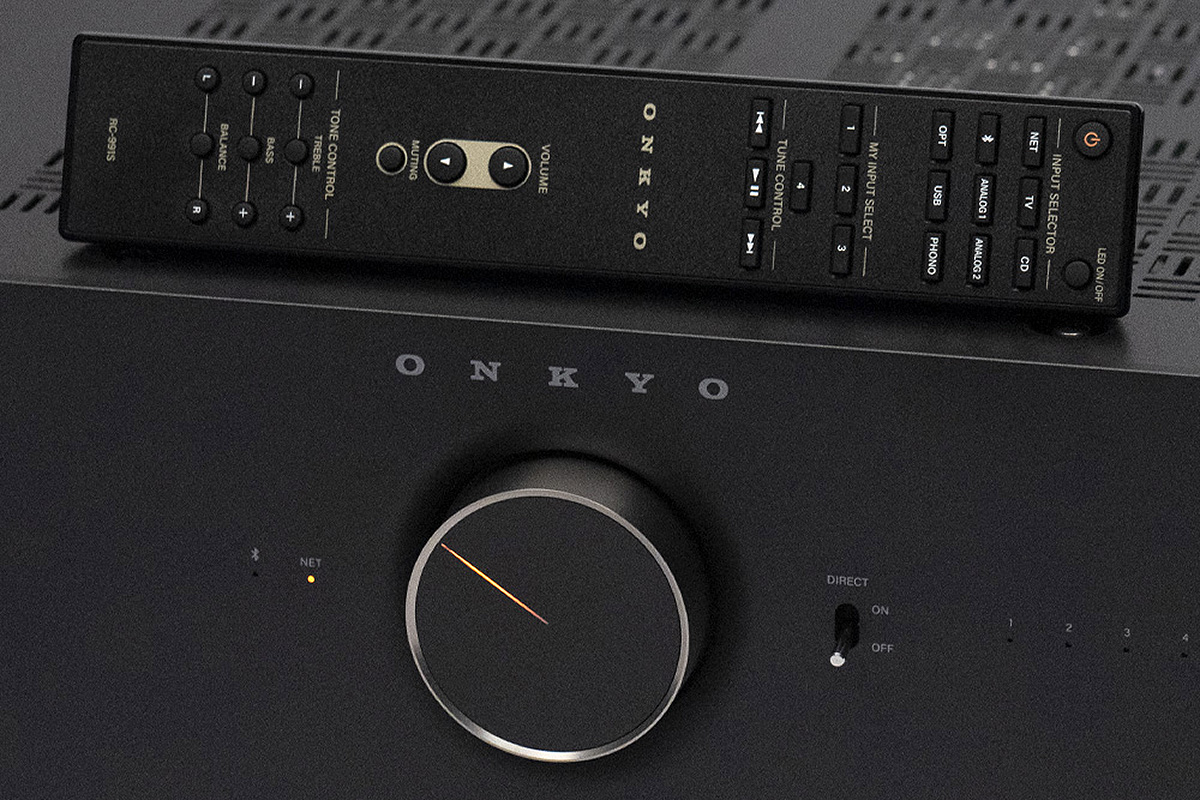
It’s the sort of touch you don’t necessarily expect from a $1600 streaming integrated amp, especially one from a big-box brand such as Onkyo. But I’m here for it. I see absolutely no reason why petite bourgeoisie products like this can’t feature some wholly superfluous niceties, because while they don’t affect performance, of course, they do influence user enjoyment. And that’s frankly almost—not quite, but almost—as important in a day and age when you can sometimes take raw performance for granted.
Of course, if you want to take the Onkyo Icon vibes to the next level, there’s also the P‑80 streaming preamp and M‑80 power amp, the latter of which adds drop-dead-sexy VU meters and a bit of extra headroom, along with some additional advanced features. But for most people, the A‑50 integrated likely has all the output—not to mention swagger—you’ll ever need.
Inside and out
OK, let’s get back to those under-the-hood differences between the Icon A‑50 and the Muse Y‑40 I recently reviewed for Access, some of which turned out to be more consequential than others.
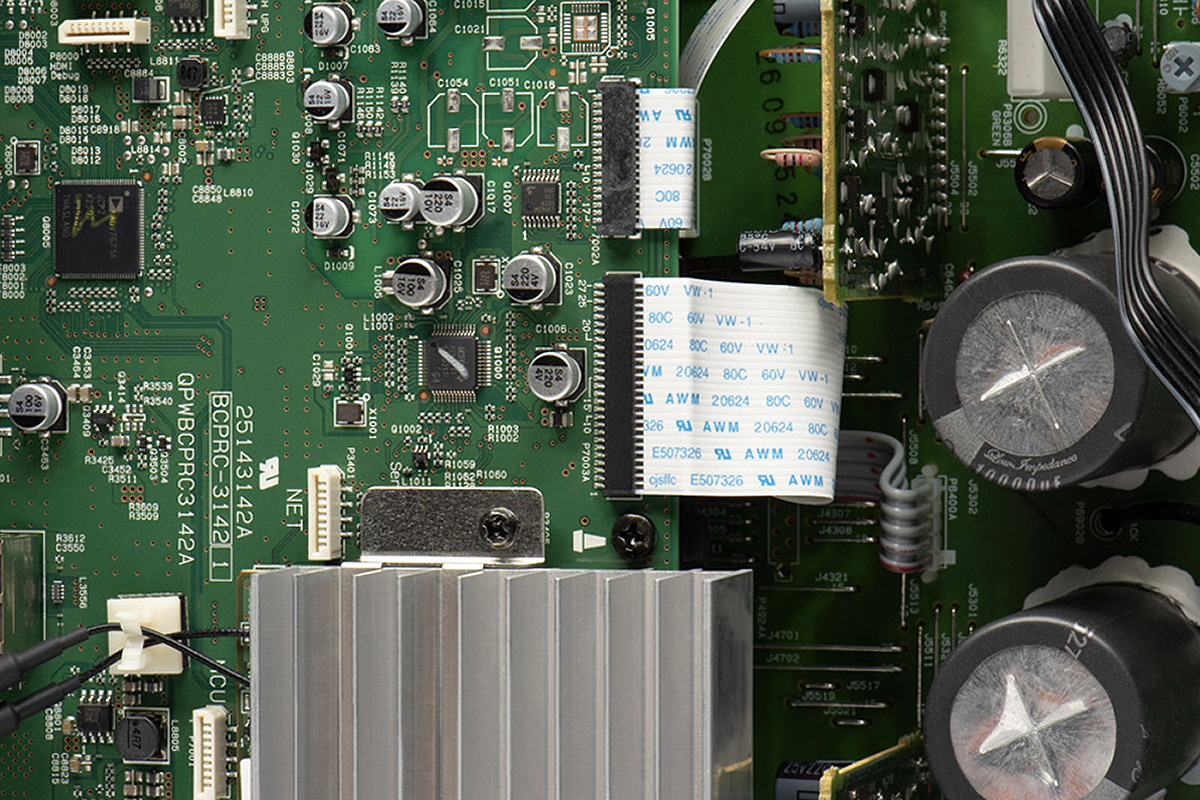
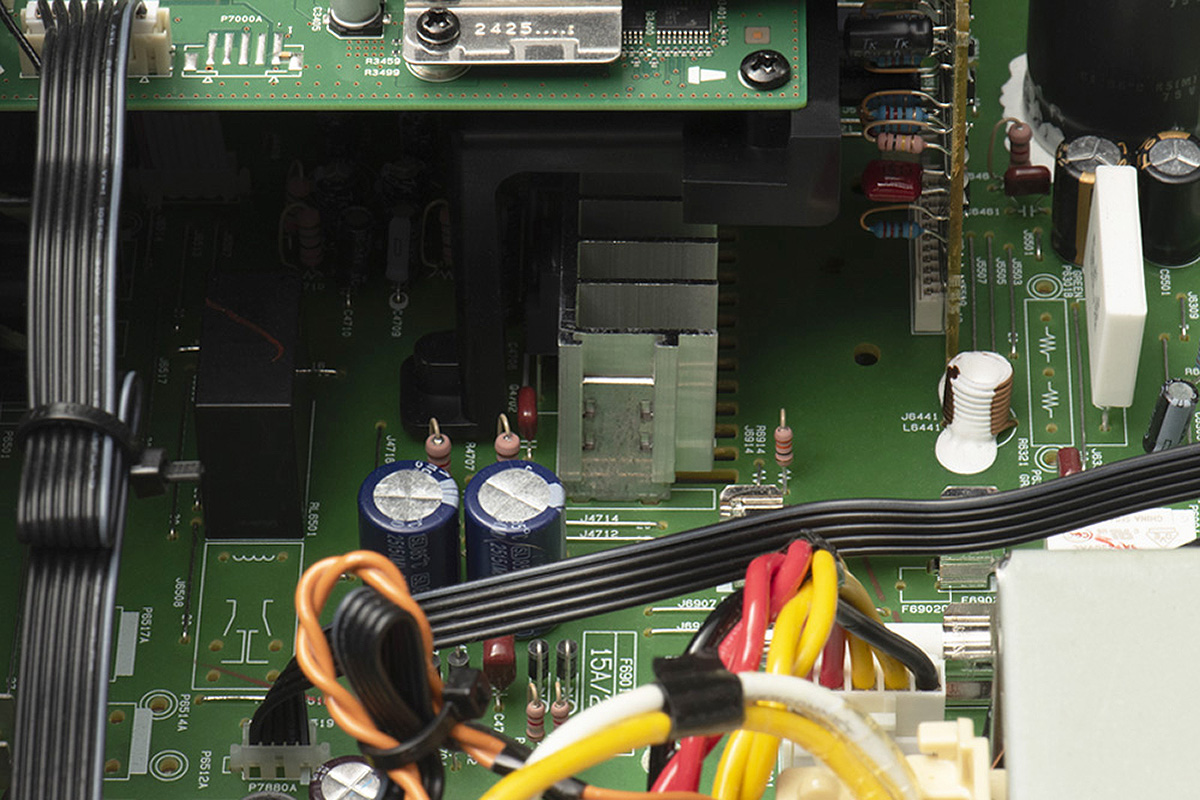
Perhaps somewhat oddly for a streaming integrated amp, the A‑50 relies on three-stage inverted Darlington circuitry in its class-AB output stage, with power rated at 110Wpc into 8 ohms (full bandwidth, 0.07% THD, both channels driven) and 180Wpc into 4 ohms (1kHz, 0.7% THD, both channels driven). Onkyo recommends using the A‑50 with loads of 4 to 16 ohms, which is something to consider if the impedance curves of your speakers spend much time significantly below that at any point in the audible range, especially the bass. Most speakers you’d pair with an amp in this price range almost certainly represent a load it can handle just fine, though.
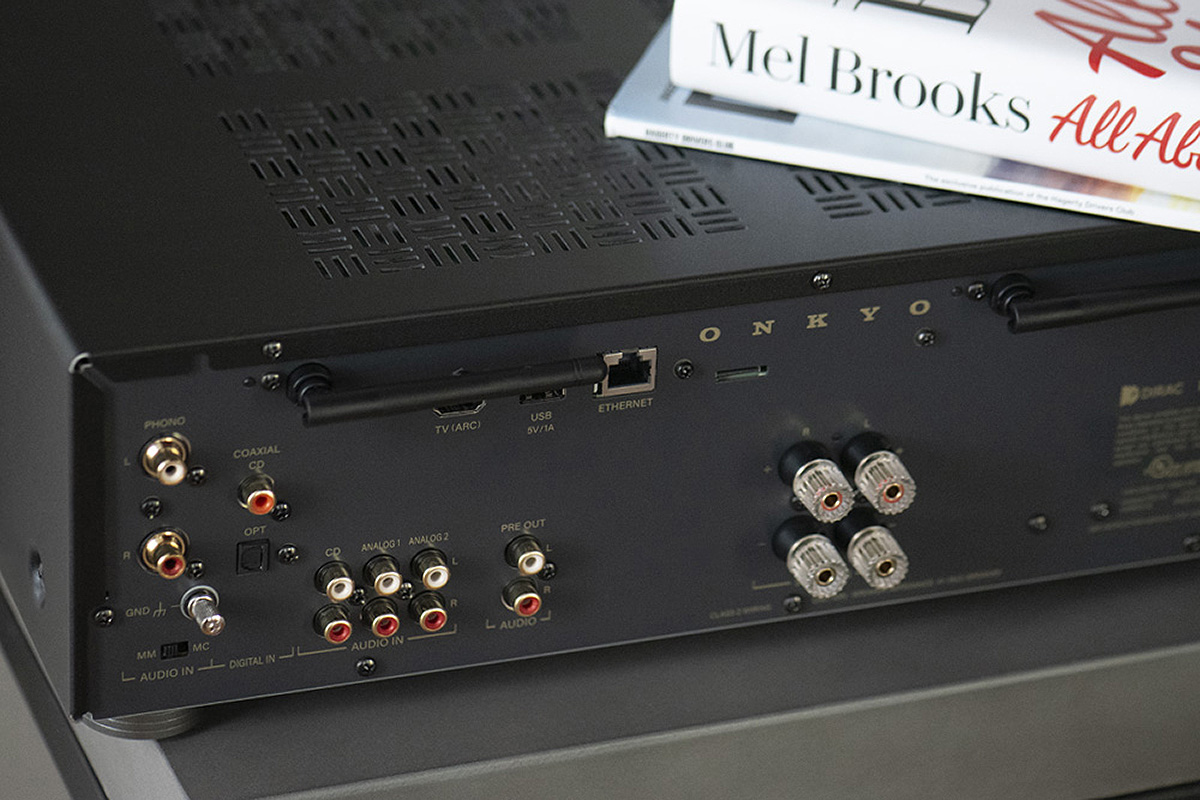
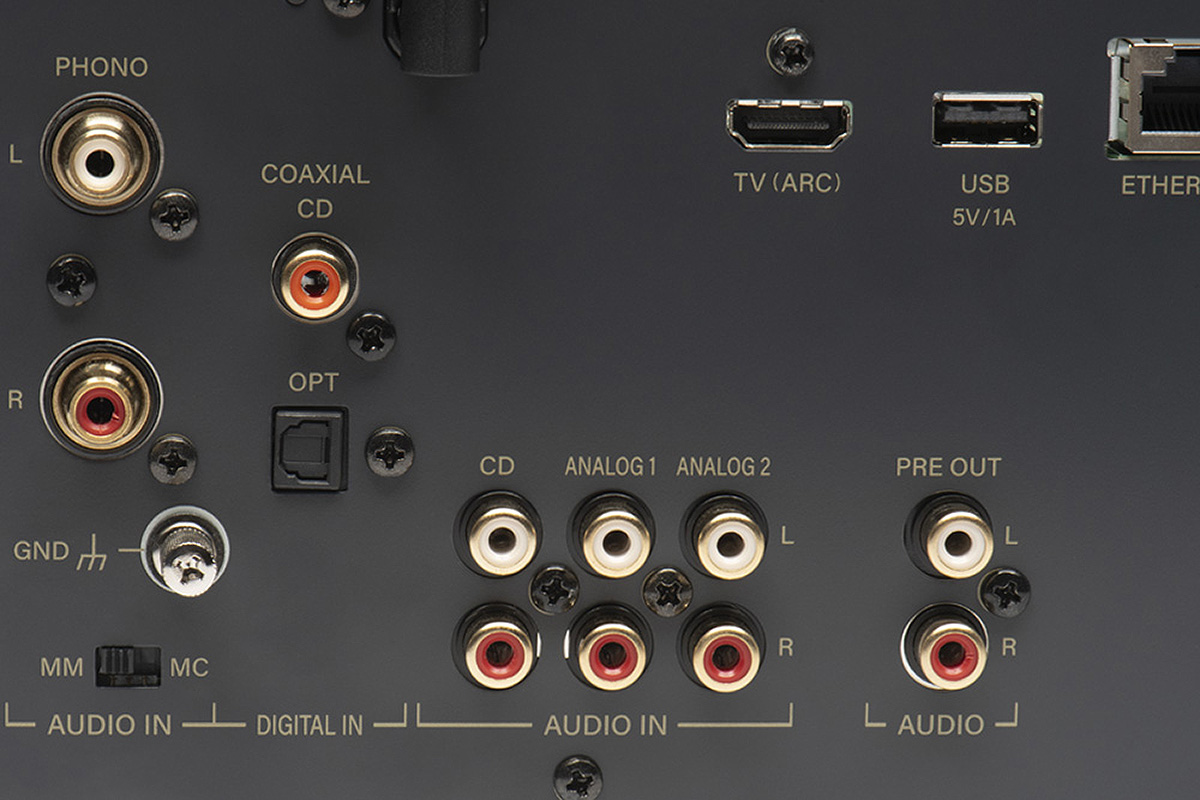
I/O includes a phono input with support for MM and MC cartridges, three line-level RCA inputs (one labeled “CD,” the other two labeled “Analog 1” and “Analog 2”), optical and coaxial digital ins (the latter also labeled “CD”), an HDMI ARC port, ethernet, two wireless antennas for Wi‑Fi and Bluetooth (version 5.1, with support for SBC and AAC codecs on incoming signals and SBC, aptX, and aptX HD for outgoing transmissions), and a USB‑A port that I couldn’t get to work—despite the fact that I was using the same flash drive I’d just unplugged from the Onkyo Y‑40, on which the port did work, but only insofar as it would play music files stored on the drive in order of the filenames, with no controllability whatsoever. So I didn’t much lament the fact that the A‑50 wouldn’t detect the drive, nor another USB storage device I plugged into it.
There’s also a 6.35mm (¼″) headphone output on the front panel. Compared with the Y‑40’s headphone output, which I had just tested just days before, the A‑50’s similarly drove my AKG dynamic and Audeze planar-magnetic headphones just fine, with no audible noise, although I did have to turn the volume up a little more with the latter. Still, there was plenty of headroom, so unless you have some seriously thirsty cans that need a dedicated headphone amp, you’ll likely be more than satisfied with the A‑50’s personal listening experience.
Setup and software
The Icon A‑50 relies on the same Onkyo Controller app as most of the company’s connected gear for setup, source selection, streaming, and other control functionality. You need to use the app to connect the A‑50 to your Wi‑Fi network. I did this, and it worked fine. But for most of my testing, I connected the A‑50 to my home network via ethernet.
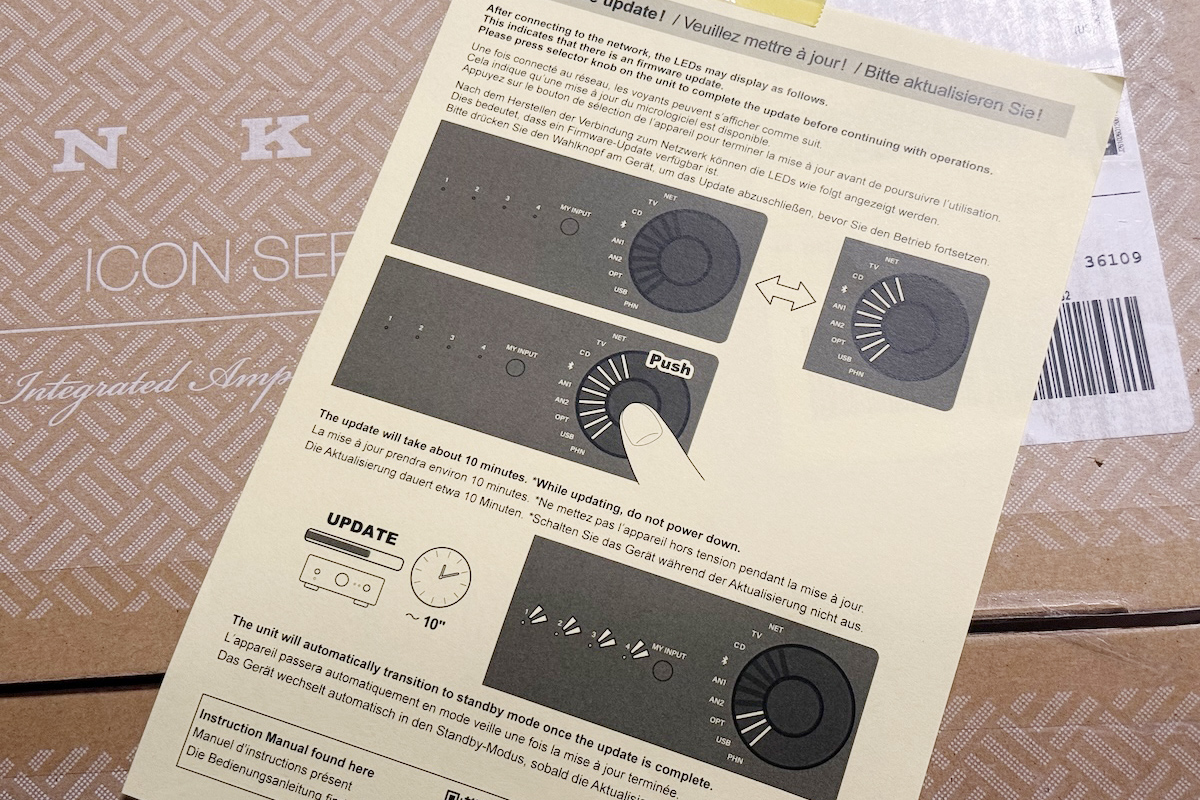
The first time the A‑50 connects to the internet, it will check for firmware updates, and if one is available, the source-select knob on the front of the amp will flash red. Boop the button to initiate the update process (with a bit of a leap of faith, given the lack of a display screen), and within minutes you’re ready to rock.
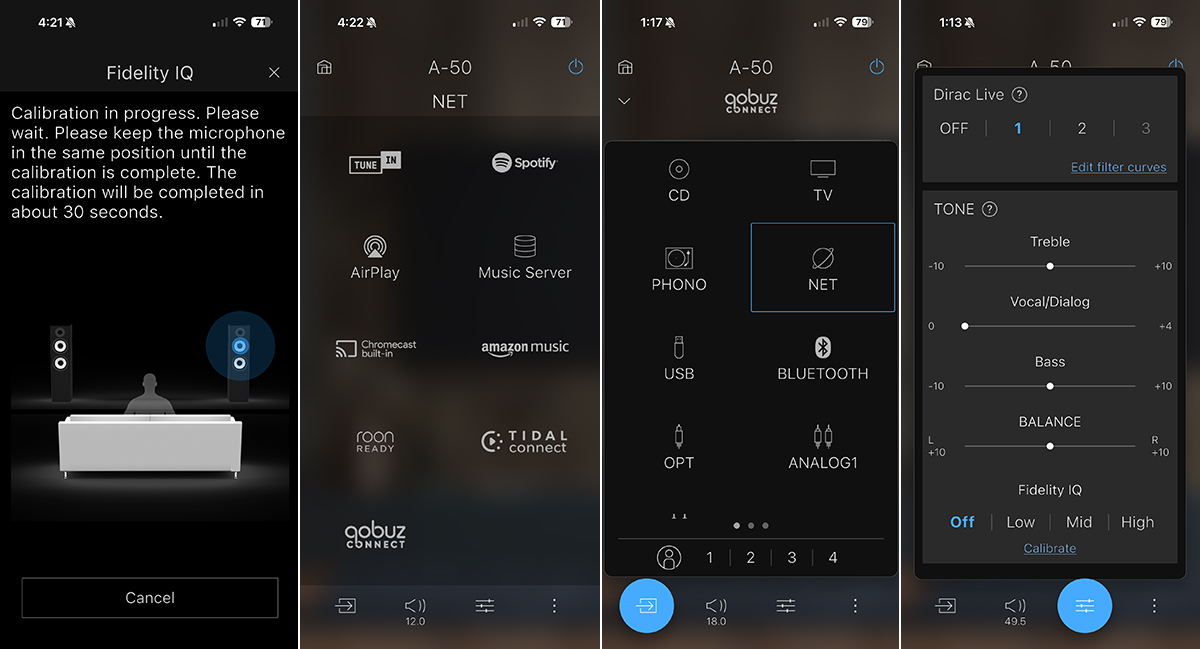
In addition to app-based control, the A‑50 supports the major “Connects,” including Tidal Connect, Spotify Connect, and even Qobuz Connect, which worked just fine with this model, despite the fact that I couldn’t get it to work with the Y‑40 (leading me to believe there’s a firmware update imminent for that model, which should benefit whoever gets my review sample next). The A‑50 is also Roon Ready and supports AirPlay 2 and Chromecast, and the app provides access to Amazon Music and TuneIn. Relying as I did on AirPlay and Qobuz Connect, I rarely found a need to dig into the app after initial setup.
Speaking of initial setup, the first thing you’ll be prompted to do once you get the amp up and running is plug in the included microphone and run not Dirac—not yet—but rather level calibration for Onkyo’s Fidelity IQ, which isn’t an alternate room-correction system so much as a dynamic loudness-control function, similar to Audyssey Dynamic EQ. Fidelity IQ has three levels of intensity, and I’ll admit to enjoying what the lowest setting did to provide richer bass at quieter listening levels, so I could still feel my tunes while my wife was napping or reading. Higher intensities were a bit much. But for all of my critical listening, I left Fidelity IQ turned off entirely.
You can engage Fidelity IQ in parallel with Dirac Live, should you choose to run it. The A‑50 comes with a license for the band-limited version of Dirac Live, which applies frequency-response filters up to 500Hz. I think that’s more than sufficient for most systems in most rooms, as the bulk of the problems best handled by DSP will almost certainly be in the lower frequencies. That said, I do often like to run correction filters in my listening room up to around 900Hz, and if you prefer the same, the full-bandwidth upgrade is available for US$99. Despite what some of the product listings would indicate, the A‑50 does not support Dirac Live Bass Control (no subwoofer out, after all), although the P‑50 preamp does. Neither supports Dirac Live ART (Active Room Treatment).
Onkyo doesn’t provide target curves of its own, leaving you with Dirac’s default, which is a bit flat for most people’s tastes (and a bit bright for mine). So especially if you plan on running full-range correction, I’d recommend opting for something like NAD’s target curves or, better yet, something akin to the custom target curve provided by True Target by Magic Beans Audio, which gave me the best results out of all my tinkering.
Since, as noted, the A‑50 doesn’t have a subwoofer output, I fed its output to my reference Paradigm Studio 100 v.5 towers, connected with a pair of SVS SoundPath Ultra speaker cables.
Sources included my iFi Audio Zen One Signature DAC connected to the Analog 1 input, my U‑Turn Orbit Theory turntable, my iPhone 16 Pro Max, and my Oppo BDP‑93 universal Blu-ray player, connected via a Monoprice 1419 TosLink cable as well as a Monoprice HDMI cable. And, of course, Onkyo Controller itself, which—as I said above—was handy for setup, but pretty much superfluous after that.
Listening impressions
As is often the case, I think it might be beneficial if I spell out exactly what’s going through my mind when I start to evaluate an integrated amp like the Icon A‑50. What clues help me decide which things I should pay attention to first? Honestly, the fact that the rated output doesn’t double when impedance halves—while not as concerning as some people would lead you to believe—was still worth investigating to ensure that the amp doesn’t have heat-dissipation issues and isn’t current-starved. Still, 110Wpc/180Wpc is substantially more power than I’d ever need to feed my Paradigm speakers in any room in my house, so I wasn’t too concerned. But this seemed the most logical place to start my testing, just to figure out where the A‑50’s limits might lie.
Those of you who read my reviews regularly will know the tracks I normally go to for testing out an amp’s power supply (and/or output impedance, etc.). But I decided to mix things up this time and push the A‑50 to hell and back with “Forty Six & 2” from Tool’s Ænima (24‑bit/96kHz FLAC, RCA Records / Qobuz). The bass in this one is absolutely relentless: hard-hitting, nearly constant, slammed to 11 from beginning to end.
Around the 4:35 mark, though, there’s a bass-drum fill that can—if your amp is struggling, or can’t power through the impedance swings of your speakers—sound weak and out of proportion with the rest of the mix. That was far from the case with the A‑50. Even cranking out 100dBA SPLs with 116dB peaks—far from a sane listening level, and I could only handle it for so long—the bass stayed well-controlled and powerful, not to mention perfectly in proportion.
Granted, the top of the amp got toasty. For-real toasty. About on par with the top of a modern Denon A/V receiver after watching an Avengers movie. But performance never took a bit of a hit. This track also provided the best test of the amp’s Dirac capabilities, especially with regard to controlling the bass. With Dirac engaged, note-to-note consistency was improved and the lowest frequencies were delivered with more authority and less distraction overall.
Next up on my list of things to investigate: is the DAC reconstruction filter doing anything stupid? Probably not, given that this is Onkyo, and the company typically relies on AKM DAC chips. I can’t find anything in the specs for the A‑50 that indicates which chip is employed here, but I did some A/B comparisons between the A‑50’s DAC, using its optical and ethernet network inputs, against the output of my iFi Audio DAC, relying mostly on “Ellipses” from Andrew Bird’s Echolocations: River (16/44.1 FLAC, Wegawam Music Co. / Qobuz), which has a lot of very-high-frequency hash up near and even above where my hearing acuity starts to run out.
Some of the sillier audiophile slow-rolloff filters can diminish the sense of space with this field recording, so that’s one thing I really listened for. In truth, I couldn’t hear any meaningful difference between any of the inputs (and I was relying on the CD as one of the sources, for what it’s worth), all of which says to me that the DAC is doing its job, it’s well implemented, and there are absolutely no concerns in the digital-to-analog department.
Echolocations: River is also a good test album to use when making subjective evaluations of soundstaging and imaging, although different tracks spotlight different strengths and potential weaknesses. “Lazuli Bunting,” for example, is a great imaging test, especially the hand-clapping that serves as percussion. There’s a lot more specificity to the placement of the claps than there is to almost any other element of the album’s overall mix, and they were rendered precisely here.
For soundstage, I lean more toward “Black-Crowned Night-Heron,” which brings the mike a lot closer to the burbling water, providing the background canvas for the entire composition, but also features a lot of natural reverberation, which results in the decay of Bird’s bowed violin really wafting out into the room. Both tracks sounded absolutely delightful through the A‑50.
“10 out of 10,” as the kids say these days. “No notes.”
Given my experiences with the Y‑40’s phono stage, I was curious about how the phono stage of the A‑50 would perform, given that it’s a switchable MM/MC preamp, not merely MM. In case you didn’t read that review, the phono input of the Y‑40 simply didn’t provide sufficient gain when paired with my U‑Turn Theory turntable, and it didn’t play well with the fact that said turntable grounds on the RCA output, and as such lacks a grounding terminal.
Thankfully, the Theory and the A‑50 turned out to be a much better match. I was able to come much closer to level-matching the phono input with digital sources, and as such could make more meaningful comparisons between King Gizzard & the Lizard Wizard’s Omnium Gatherum on vinyl (KGLW‑013‑2LP) and the digital version (24/48 FLAC, KGLW / Qobuz), which is simply a needle-drop of the test pressing. I’m much more confident in saying here that Onkyo’s RIAA compensation results in a good tonal balance than I was when reviewing the Y‑40.
Swapping out the KGLW for my VMP pressing of Fleetwood Mac’s Fleetwood Mac (VMP‑E134), I was impressed by the low noise overall, the excellent dynamic punch, the wonderful separation, and the fact that my nearby lamp contributed absolutely zero hum to the signal. I wish I could have also tested the A‑50’s MC capabilities, but I’m not quite there yet on my vinyl journey. Someday . . .
For folks with MM cartridges, at the very least, I can tell you that the phono stage of the A‑50 is good enough that you don’t need an external phono preamp. The only thing you could really knock it for, in my opinion, is that the rumble filter, while good, isn’t as good as the one on the Pluto 2 phono preamp built into my U‑Turn ’table.
Comparisons
I haven’t tested the Muse Y‑50 ($1499 USD), the step-up sibling of the Y‑40 I did review; however, if you’re liking what Onkyo is up to these days but want a display screen, an HDMI input as well as the ARC port, actual bass management and Dirac Live Bass Control support, and reliance on more efficient and cooler-running class-D amplification with 125Wpc into 8 ohms and 250Wpc into 4 ohms, it’s worth considering for US$100 less than the cost of the A‑50. As I write this, the Muse Series amps still haven’t hit the market, and I did experience some issues using Qobuz Connect with the Y‑40 that I assume will be sorted out in the first big firmware release, so that’s something to consider. It’s also worth noting that—as I keep saying—these amps have very different vibes and are likely to appeal aesthetically to very different shoppers. And aesthetics do matter to me, so take that for what it’s worth.
The NAD C 3030S (US$1499 USD, CA$1699, £1149, €1299) is another strong contender, with a very different design and different strengths and weaknesses. The BluOS streaming and multiroom audio platform is much more refined and fully featured than Onkyo Controller, but the Hypex amp modules only deliver 50Wpc into 8 or 4 ohms—still more than enough for my needs, but your mileage may vary. The amp is also stable into 2-ohm loads, which may or may not matter in your system. The biggest area in which the C 3030S falls way short of the Onkyo A‑50 is in its analog connectivity—it only has one phono in and one line-level stereo RCA in, and its phono input supports MM cartridges only.
Conclusion
I continue to have concerns about the Onkyo Controller platform, and I sure do wish the Icon A‑50 had a subwoofer output and bass management. But as for the former issue, it’s so easy to get music to the amp in many different ways that I doubt you’ll ever need to open the dedicated app. Between all the “Connect” support, AirPlay 2, Chromecast, and Bluetooth—not to mention Roon—Onkyo’s proprietary streaming and multiroom control platform is largely redundant, making its shortcomings easy to forgive.
More difficult to forgive would be performance concerns, of which I have zero here. The A‑50 sounds fantastic with digital sources and vinyl alike, and it’s got a gobsmacking number of analog inputs for an integrated amp in this price range, not to mention way more power than I’ll ever need with my tower speakers in my room.
But more than anything else, I just love this thing’s personality. Literally every day that I sat down in my two-channel room and fired up the A‑50, I got a little thrill out of the startup processes, not to mention the 1980s-vision-of-the-future aesthetic. It just never, ever got old. Add some VU meters and this thing’s charm would almost be unfair. Of course, if you want such meters, you’ll have to upgrade to the P-80 preamp and M-80 amp, which more than doubles the cost of your electronics.
I very much hope the A‑50 is a sign of things to come from Onkyo, because I’m quite smitten by it, imperfections and all.
. . . Dennis Burger
Associated Equipment
- Speakers: Paradigm Studio 100 v.5
- Headphones: AKG K361, Audeze LCD‑2
- Sources: iPhone 16 Pro Max; Oppo BDP‑93 Blu‑ray player; U‑Turn Orbit Theory turntable; iFi Audio Zen One Signature DAC; custom-built PC running Pop!_OS with Cosmic Desktop 1.0.13
- Speaker cables: SVS SoundPath Ultra
- Power conditioner: SurgeX XR115
Onkyo Icon A‑50 streaming integrated amplifier
Price: US$1599.99, CA$2599.99, £1199, €1299
Warranty: Two years, parts and labor
11 Trading Company, LLC
3502 Woodview Trace #200
Indianapolis, IN 46268
Phone: 1-800-229-1687
Website: www.onkyo.com