


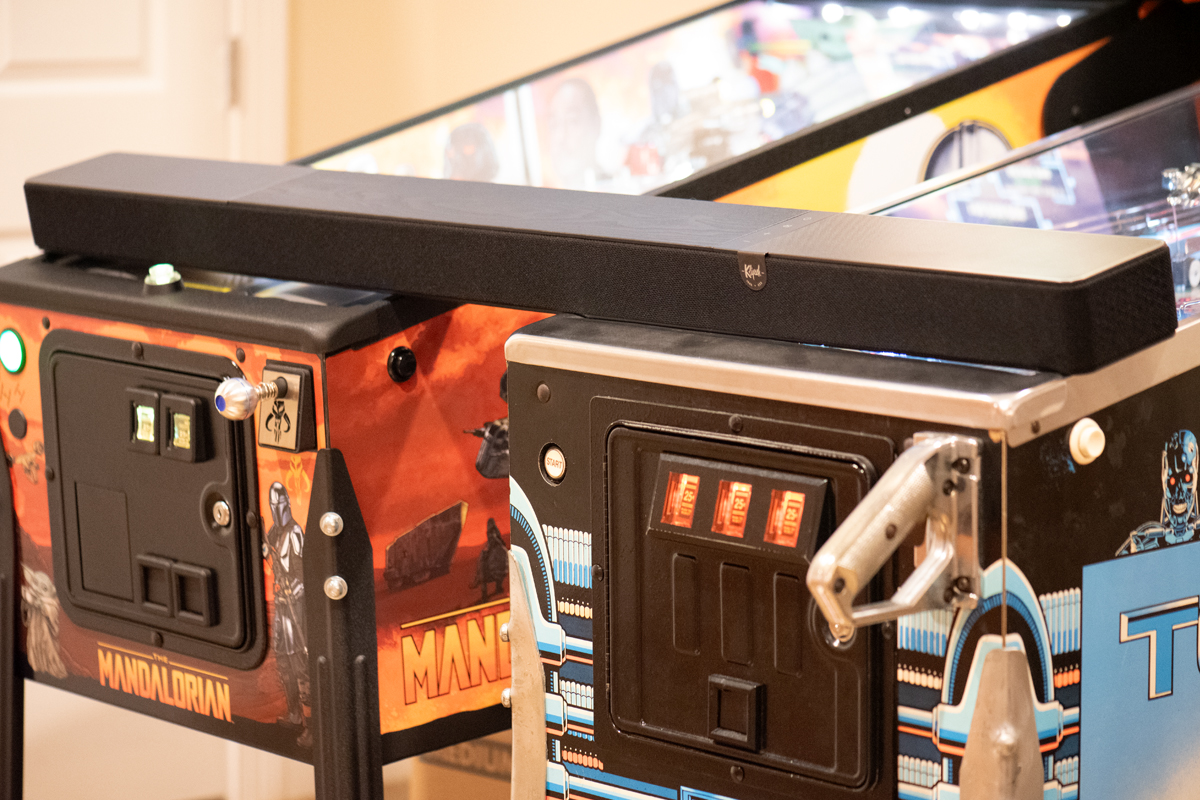
 Soundbars are generally thought of as a cheap, unfussy way to improve the audio part of the TV-viewing experience. The category tends to earn its “audio appliance” rep, though brands like Sonos have managed to elevate soundbars somewhat through features like built-in music streaming, room correction, and an ability to add wireless rear speakers and subwoofers to scale up to full surround sound. Klipsch’s Flexus Core soundbar family follows Sonos’s lead with a surround-sound scaling option. The company’s flagship model, the Klipsch Flexus Core 300 (US$1199.99, CA$1499, £1049, €1199), takes things even further by adding built-in streaming and Dirac Live—a sophisticated room-correction solution typically found in high-end A/V receivers and integrated amplifiers.
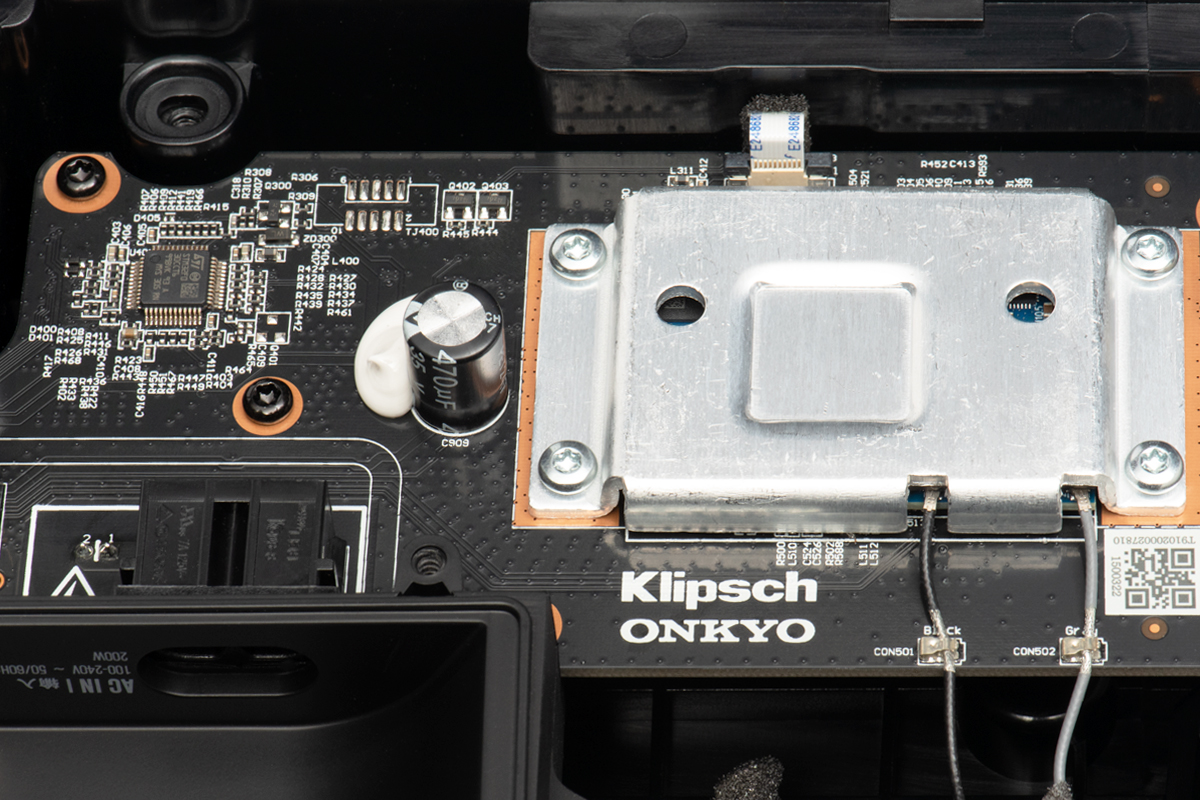
The Klipsch Flexus Core 300 is a 5.1.2-channel soundbar with built-in decoding for the Dolby Atmos and DTS:X soundtrack formats. An Onkyo-designed internal amplifier (no output specification provided) powers the soundbar’s 13 drivers, and the frequency response is specified at 43Hz–20kHz. Klipsch offers multiple wireless rear-speaker and subwoofer options for the Core 300. For this review, I used it with the Flexus Sub 200 subwoofer (US$599.99) and Flexus Surr 200 rear speakers (US$499.99/pair). This setup resulted in a 7.1.4 system, thanks to the latter’s upfiring drivers.
Unlike Dolby Atmos–compatible soundbars that rely on virtual Atmos processing for height effects, the Core 300 delivers the height effects in Atmos and DTS:X soundtracks through upfiring speakers that bounce sound off the ceiling. An HDMI eARC port is provided for connection to a TV, and there’s also an HDMI 2.1 pass-through input for a game console or other source.
The Core 300 also has ethernet, Wi‑Fi, and Bluetooth connectivity, and a built-in streamer supports Tidal Connect, Spotify Connect, Apple AirPlay, and Google Cast, giving higher-quality options for music playback than Bluetooth.
Inside and out
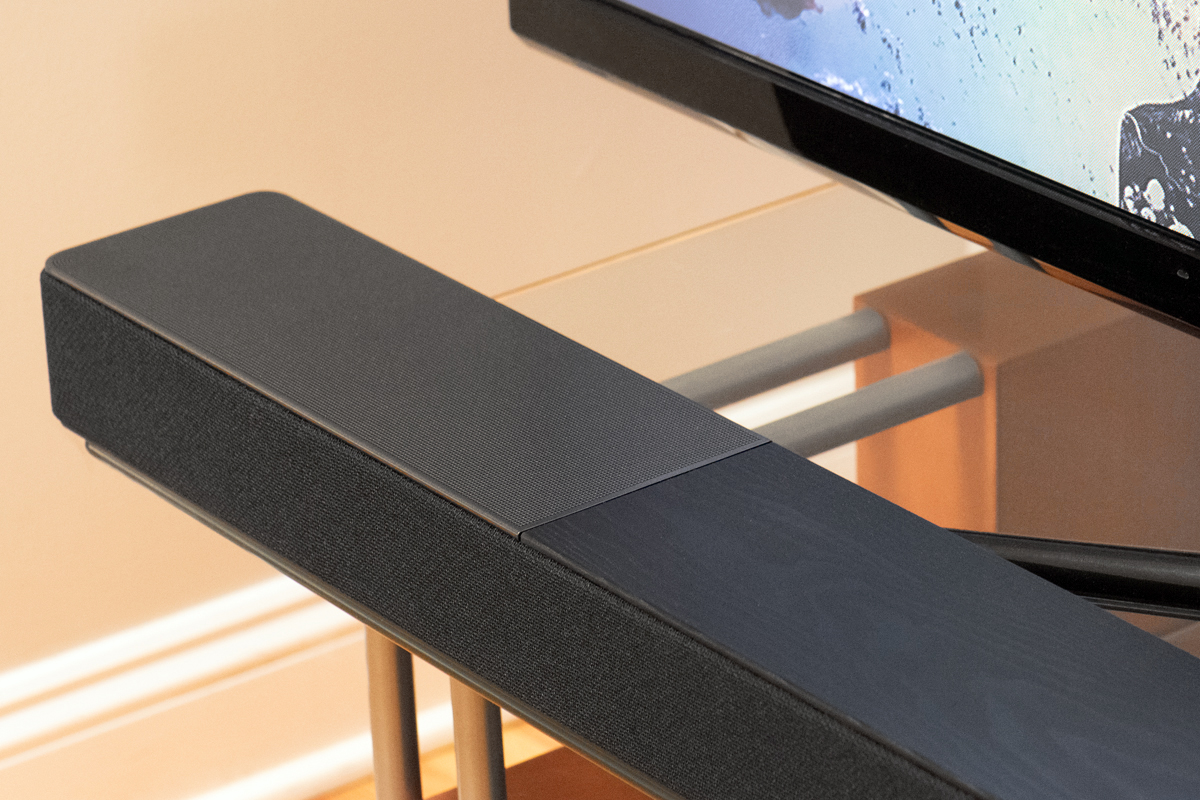
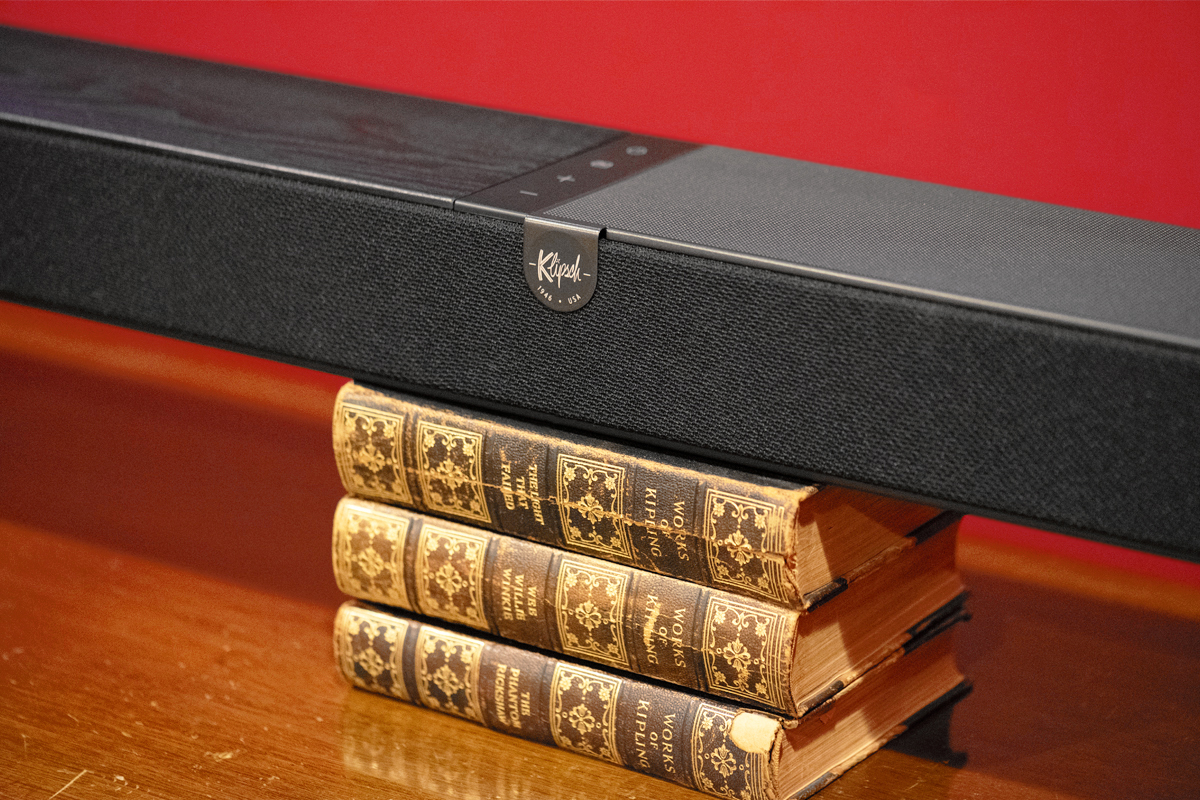
The Core 300 is better-looking than your average soundbar, especially in the walnut finish option (I was sent the basic black version to review). The plastic-and-metal enclosure has rounded corners, and black mesh cloth covers the bar’s front and sides. A faux-woodgrain panel runs across most of the top surface, broken up by metal grilles covering the upfiring speakers. Basic controls for power, input selection, and volume are also located on the top of the soundbar.
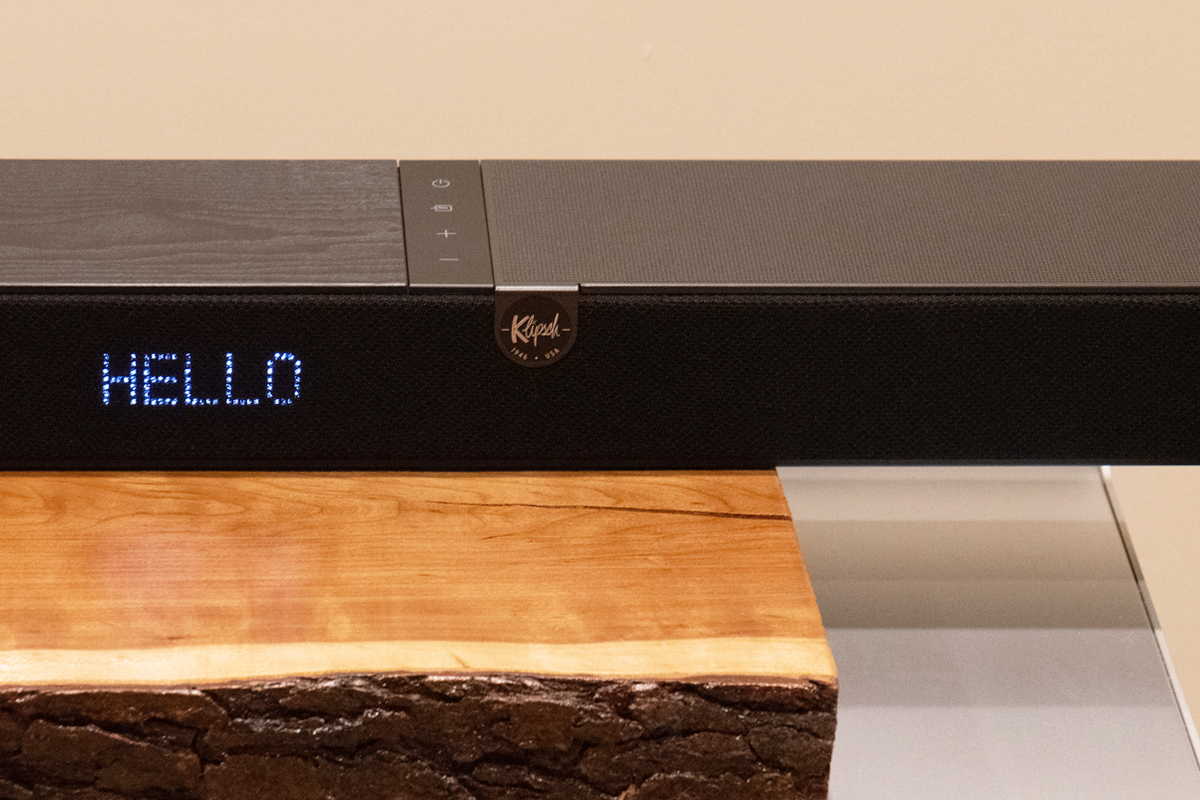
Klipsch includes a full-featured remote control—a welcome addition, and an accessory that’s not included with other flagship soundbars such as the Sonos Arc Ultra and Bluesound Pulse Cinema. The remote allows you to carry out most of the adjustments you’ll want to make, such as switching inputs, boosting dialogue or bass level, engaging night mode for dynamic-range leveling, and adjusting height effects on the Core 300 (plus surround and height effects on the Surr 200 rear speakers). You can’t adjust the EQ or enable Dirac Live room correction with the remote, both of which require the Klipsch Connect Plus app.
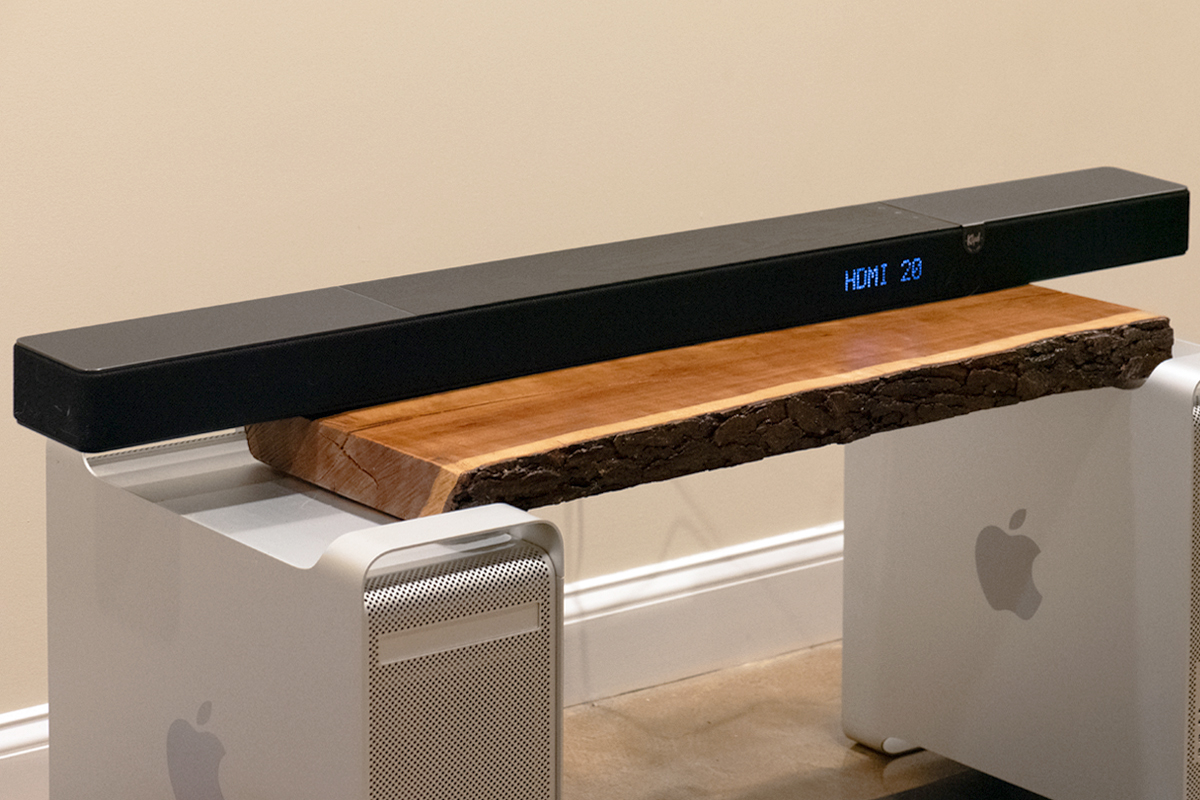
Another welcome feature that differentiates the Core 300 from flagship soundbars by Sonos and Bluesound is an alphanumeric LED display on the soundbar’s front. It’s large and bright enough to be easily read from a distance, and provides feedback for any adjustments you make using the remote control or app. The display can be dimmed or switched off completely.
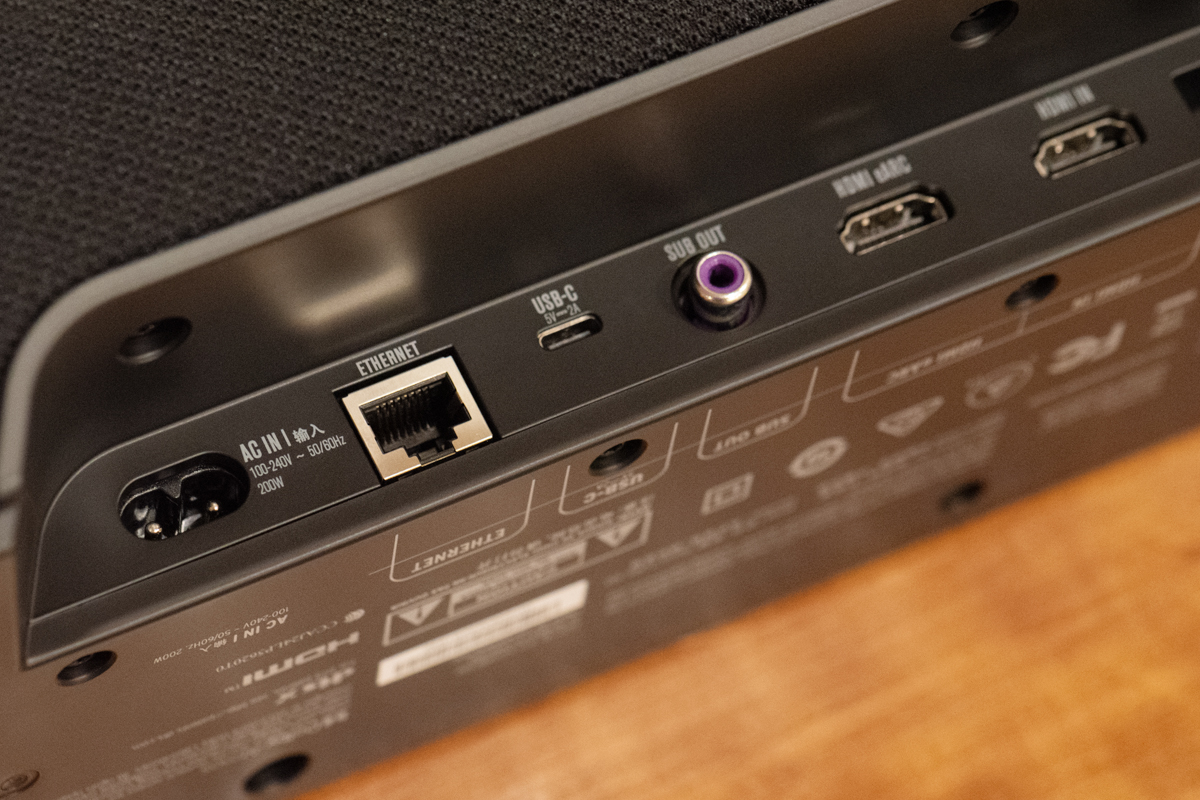
Along with its HDMI eARC and HDMI pass-through ports, the Core 300 has an optical S/PDIF (TosLink) input, a USB‑C port (for service only), and a USB‑A port for the wireless dongle that provides a connection to Klipsch’s wireless surround speakers and subs. There’s also an RCA subwoofer output for hooking up a wired sub.
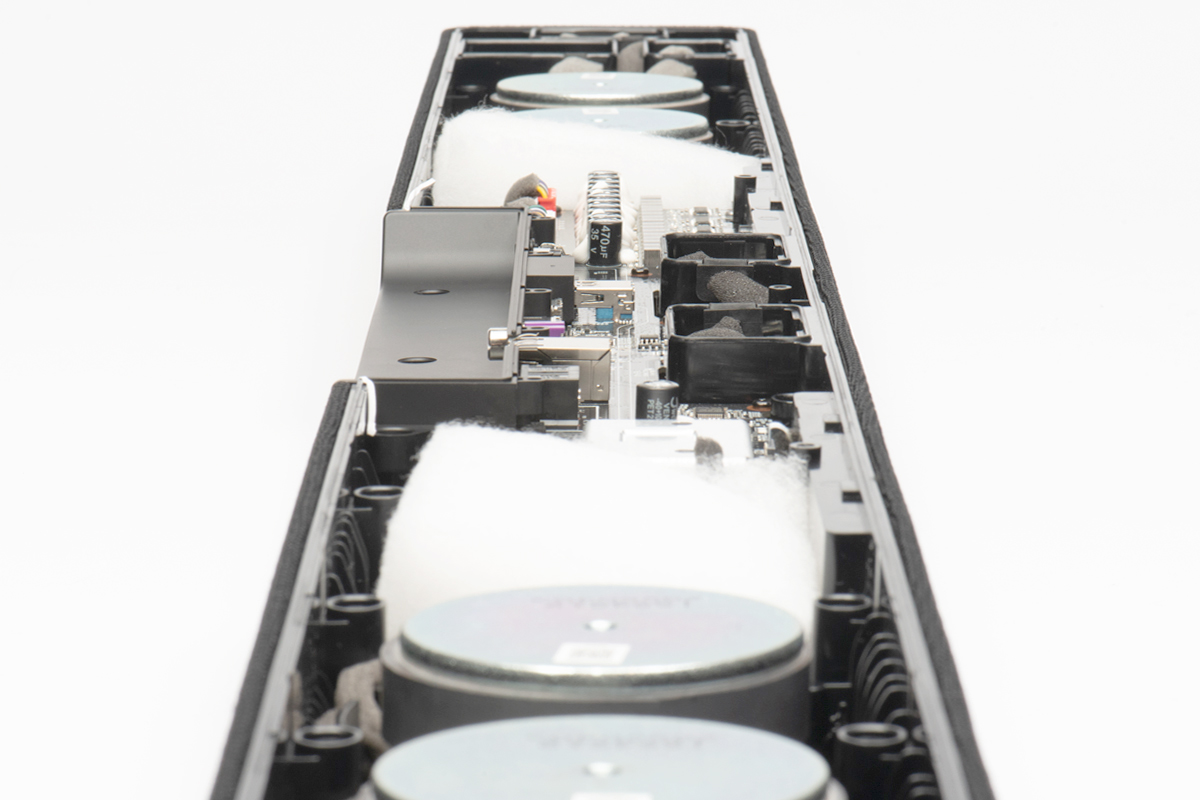
Two 2.25″ paper-cone drivers are used for the Core 300’s upfiring speakers, and side-mounted 2.25″ drivers provide a degree of surround-sound envelopment. The rest of the Klipsch’s speaker array consists of one 2.25″ driver each for the left and right channels, an additional 2.25″ driver pair flanking a 0.75″ horn-loaded tweeter for the center channel, and four 4″ woofers on the soundbar’s top surface.
Setup and software
Setting up the Core 300 in my system was as simple as placing it on my TV stand, plugging it in to an outlet, and connecting it to my TV’s HDMI eARC port. At 54″W × 3.1″H × 4.9″D, Klipsch’s flagship is undeniably large for a soundbar. Widthwise, it was a good match for my 75″ set, and would also work with a 65″ screen, but any smaller TV would be a mismatch. The soundbar’s 3.1″ height also meant that it partially obscured my TV’s IR receiver window, making it difficult to use the set’s remote control.
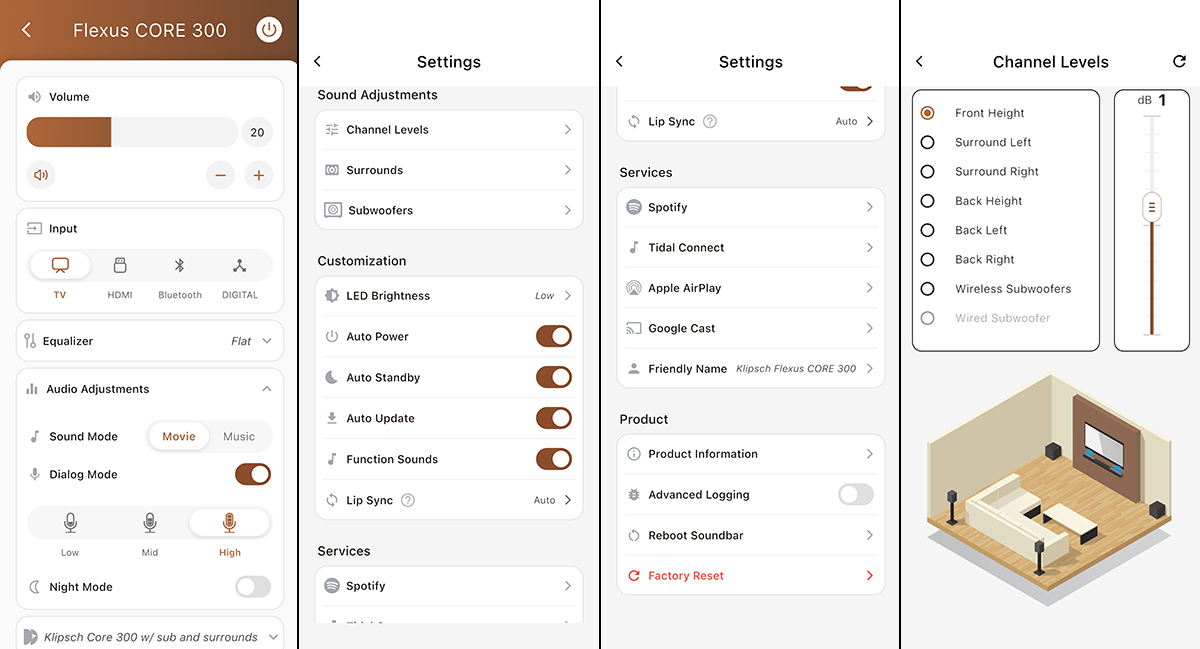
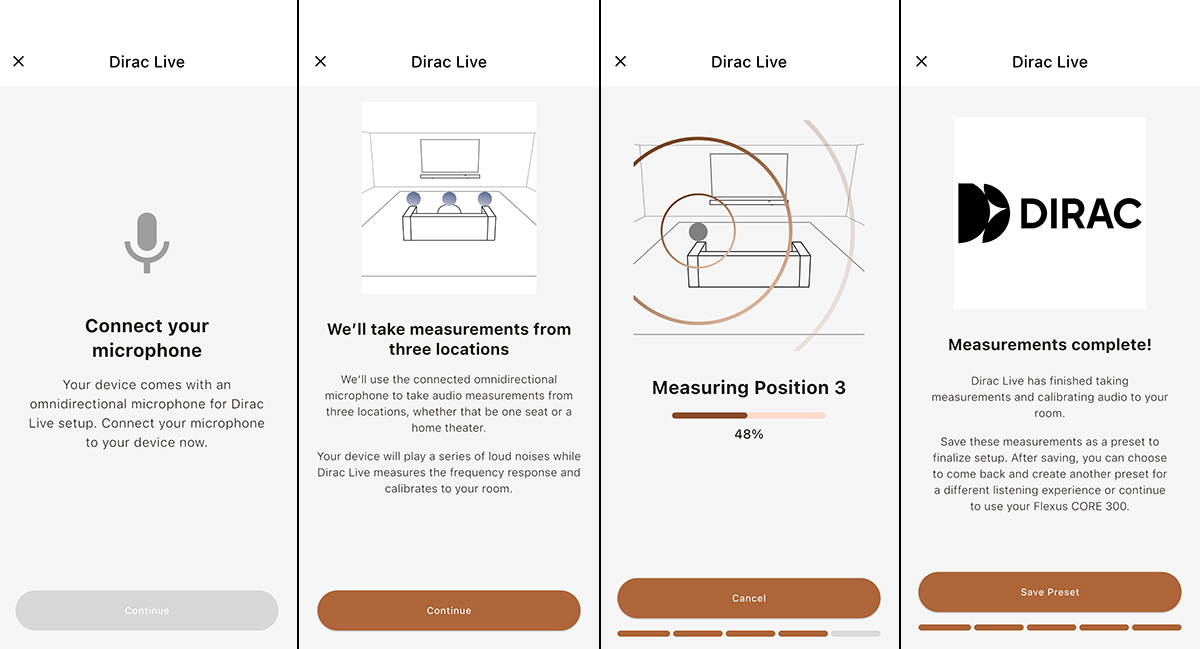
The Klipsch Connect Plus control app duplicates most functions of the physical remote control. It also provides a three-band EQ with some standard presets, plus a customizable preset option. The app is used to set up the Core 300’s streaming connections, and to create Dirac Live room-correction filters using a calibrated measurement mike that’s packaged with the soundbar.
To get going with Dirac Live, you plug the microphone into a 3.5mm jack on the soundbar’s back panel and position the microphone at head height in the primary listening seat. (I used a tripod to ensure accurate measurements, taking advantage of the tripod screw located on the mike’s bottom surface.) With the app guiding you through the steps, the soundbar emits a series of test tones, and you move the mike to the left and right of the primary seat to capture measurements at those locations. Once that’s done, a correction filter is created, which you can save with a custom name.
The Core 300 ships with a basic Dirac Live license that limits room correction to the sub-500Hz range. You can upgrade to a full-range license for US$99. Klipsch provided the upgrade for my review, so I was able to create a more comprehensive room-correction filter for the full Core 300 system with Sub 200 subwoofer and Surr 200 rear speakers using the Dirac Live Windows/macOS software suite.
You can read more about the Dirac Live software suite here. In a nutshell, it gives you the ability to perform measurements at up to 13 locations to create a more accurate map of the interactions between the speakers and your room, and to add frequency-range “curtains” to individual speaker groups—left and right front, surrounds, and subwoofer, for example—for correction. It also lets you tweak the correction curve to taste after listening to the effect after processing is applied; bumping up the mid-bass or shelving the high frequencies, for instance. The full Dirac Live software license offers a wide range of possibilities for customizing your system’s sound, but I’d only recommend it to those willing to commit the necessary time to explore its potential.
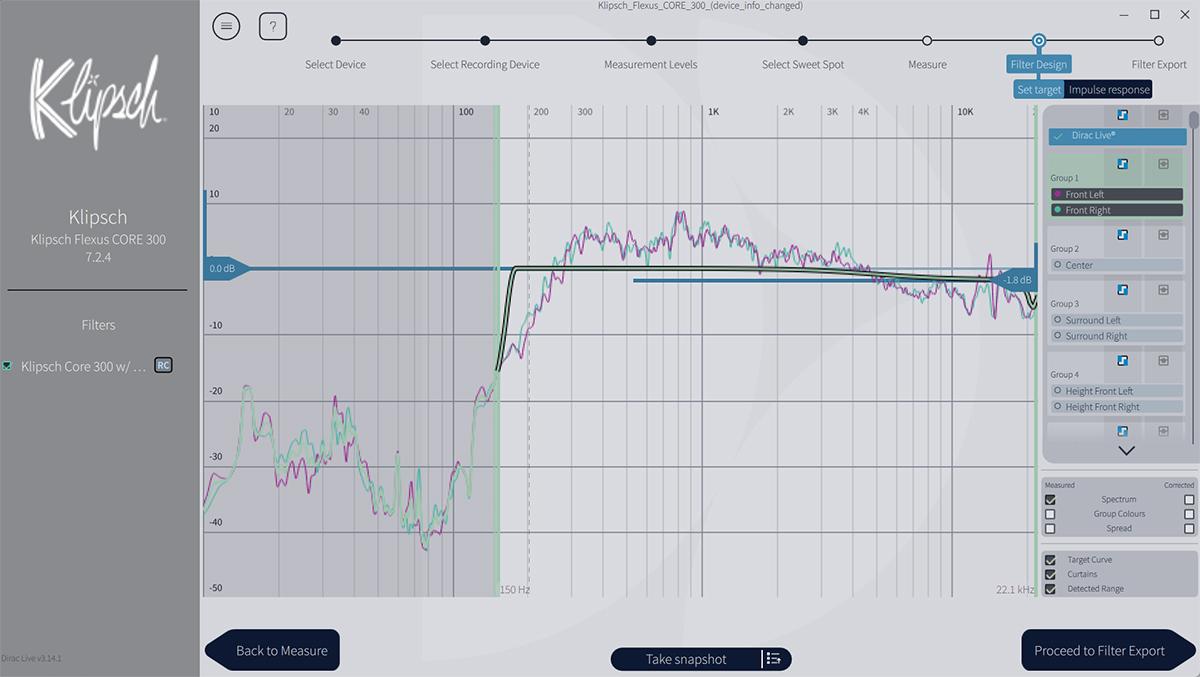
Taking measurements in my listening room with the Dirac Live software suite took about 45 minutes. I used the resulting correction filter for listening with the full 7.1.4-channel system, and the more basic Dirac filter I configured using the Klipsch Connect Plus app for my evaluation of the Core 300 soundbar on its own.
Music
I started out my evaluation with the Core 300 soundbar alone. For audio, I mostly played stereo tracks via Tidal Connect and Dolby Atmos content from the Apple Music app on my Apple TV 4K streamer. For movies, I used an Oppo UDP‑203 4K Ultra HD Blu‑ray player, and also streamed from the Apple TV 4K’s HBO Max, Apple TV, and Hulu apps. Audio bitstreams were routed to the soundbar from the TV via its HDMI eARC port for both sources.
Listening to music seemed the better opportunity to gauge the effects of Dirac Live on the Core 300’s sound, so I first streamed Aimee Mann’s “Goose Snow Cone” from the album Mental Illness (24‑bit/44.1kHz FLAC, Superego / Tidal). With the soundbar’s Music mode selected, the Klipsch presented a solid stereo image, with Mann’s voice locked in dead center. Klipsch’s Music mode, which engages the upfiring and side-mounted speakers, didn’t compromise the natural tone of the track’s acoustic guitar, strings, and vocals, but instead expanded the presentation, making it seem like the sound was coming from a conventional set of stereo speakers instead of a single, horizontal bar.
Playing this track again with Dirac Live active, the vocals had better focus, and the instruments and percussive elements like swirling bells in the background sounded clearer and more layered. I could also push the volume to a high level without the sound becoming congested, which is a common problem when listening to music through a soundbar.
I experienced much the same improvement when listening to an Atmos mix of the Beatles’ “Come Together (2019 Mix)” from Abbey Road (Dolby Atmos, Calderstone Productions Limited / Apple Music). With Dirac Live switched off, the bass guitar and kick drum on this track sounded powerful and had truly impressive low-frequency extension. The bar’s side-firing speakers also served to widen the presentation and provided a good sense of surround envelopment.
Switching Dirac Live on, the bass maintained its extended quality, but I could more clearly hear subtleties in Paul McCartney’s bass-guitar lines. The drums also had better definition, with the kick drum gaining a strong sense of presence in the mix. Guitars in the track’s chorus sounded less aggressive and edgy with Dirac Live engaged, and that gave the vocals more room to breathe. In some key ways, it seemed like I was hearing a different mix of the track—one that was noticeably better.
In other experiences I’ve had with products featuring Dirac Live, the most pronounced and easy-to-appreciate effect of the room correction was on bass, and that was certainly the case when listening to “Imaginary Friends” by Deadmau5 (16/44.1 FLAC, Mau5trap / Tidal), from the album W:/2016ALBUM/. The Klipsch Core 300’s bass sounded powerful and extended on this EDM track. With Dirac Live activated, the bass and beats sounded leaner, but in a good way, maintaining depth while gaining detail. There was a smoother overall quality to the sound as well.
TV and movies
Switching over to TV and movies, I continued my Dirac Live off-and-on experiments, first with just the soundbar and the provided soundbar-only filter, and after with my customized processing applied to the full system including subwoofer and rear speakers.
In the scene from Alien: Earth, episode 1, where a spaceship crashes into New Siam / Prodigy City, the Core 300 delivered an impressive sense of height from the standard 5.1-channel soundtrack with the soundbar in Movie mode. Debris dropping from the sky as the ship plowed into a skyscraper’s floor-level mall had a vivid effect, and there was a good sense of ambience as the medics enter the mall, shouting instructions to each other in the massive, ruined space as fashion-show videos play on LED walls in the background.
With Dirac Live engaged, the impact of the crashing spacecraft was even more dramatic, and sound effects from the falling debris came through more clearly. Significantly, the shouts of the medics were easier to hear. Also, as with music, the improved overall clarity allowed me to push the volume to a higher level without worrying about the sound becoming congested.
The opening scene from F1, which I streamed from Apple TV, is a great audio workout for Dolby Atmos soundbars and home-theater speaker systems. Played on the Core 300, the bass and drums from the Led Zeppelin track “Whole Lotta Love” sounded suitably powerful and extended, and the roar of vehicles around the Daytona International Speedway was vividly directional. Dialogue of the pit crew communicating with the drivers, along with commentary from the announcers, was clearly conveyed, and height effects like fireworks exploding above the racetrack sounded like they were genuinely coming from overhead.
Turning on Dirac Live mostly helped to bring out details in the soundtrack mix by reining in the bass and kick drum on the Led Zep track and taking off the guitar’s aggressive edge. This leaner, cleaner balance brought even more clarity to the dialogue, and it also allowed me to better hear details in the spacey middle section of “Whole Lotta Love,” such as John Bonham’s intricate cymbal work.
A scene early on in the 2024 movie Twisters (played from 4K Blu‑ray), where the young scientists seed and chase a tornado, is a hot mess of extreme wind, zipping debris sounds, and shouted dialogue. Through the Core 300, the sound effects were strongly rendered, creating a palpable wall of sound, but dialogue was somewhat buried in the dense mix. With Dirac Live, I could better make out what the doomed characters were shouting, and sound effects, like a hay bale slamming into a vehicle’s windshield, had a stronger impact. I could also better appreciate the background music score, an element that had also been buried previously.
Overall, the Klipsch Core 300 performed admirably as a standalone soundbar, and I’m sure most folks would be happy to use it without the optional subwoofer and rear speakers. Adding the Sub 200 and Surr 200s did, as I expected, add an appreciable level of bass extension and surround envelopment. However, I didn’t feel that the upfiring drivers on the Surr 200 rear speakers were contributing all that much to the overall experience, even with their levels boosted. Did I prefer having them in the system? Yes. But I don’t think anyone would be seriously short-changed by instead opting for Klipsch’s cheaper Surr 100 (US$249.99/pair), which omits the 200’s upfiring driver.
Comparison
Klipsch’s Flexus Core 200 soundbar (US$574.99) has a 3.1.2-channel speaker array and, at 3.1″H × 44″W × 4.9″D, is a more compact option than the Core 300. A key difference between the two is the presence of side-firing drivers on the Core 300, along with two extra woofers.
But that’s not all. The Core 200 omits the Core 300’s Wi-Fi streaming capability, DTS:X support, additional HDMI input for an external source device, and, crucially, Dirac Live. Otherwise, the Core 200 can be controlled with the Klipsch Connect Plus app and it supports Bluetooth for music streaming.
Playing some of the same music tracks and movie clips on the Core 200 that I had heard on Klipsch’s step-up model, there was a decreased sense of surround immersion; not surprising, given the lack of side-mounted speakers on the Core 200. Bass, while deep and extended for an all-in-one soundbar, was also less powerful, and I missed the increased clarity and detail that Dirac Live room correction contributed to the sound of the Core 300.
While it can’t be upgraded with Dirac Live, you can add Klipsch’s wireless subwoofer and rear speaker options to the Core 200 to expand the system. It may not offer the same level of performance as the Core 300, but the Core 200’s sub-$600 cost makes it excellent value for a 3.1.2-channel Dolby Atmos soundbar.
Conclusion
As the only soundbar to feature Dirac Live room correction, the Klipsch Flexus Core 300 is in a class of its own. That feature alone would make it a desirable option amidst the sea of soundbars, but the Core 300’s US$1199.99 price, which is reasonable considering all it does, makes it something of a slam-dunk for anyone looking for a high-performance, 5.1.2-channel Dolby Atmos soundbar.
Along with Dirac Live, the Core 300 features Wi-Fi music streaming with support for Tidal Connect, Spotify Connect, Apple AirPlay, and Google Cast. In addition to the HDMI eARC port, the Klipsch has an HDMI 2.1 pass-through input for connecting a game console or Blu-ray player. That’s one feature you won’t find on the Sonos Arc Ultra (US$1099), a model that could be considered the Core 300’s main competitor.
The system comprising the Klipsch Flexus Core 300, Sub 200 subwoofer, and Surr 200 rear speakers that I tested provided exceptional home-theater audio performance. There were times that I forgot I was listening through a soundbar. And at around US$2300 for the full system, I don’t expect you’ll find anything better for the price.
... Al Griffin
Associated Equipment
- Soundbar: Klipsch Flexus Core 200
- Display: Hisense 75U9N
- Sources and control devices: Apple TV 4K streamer, Oppo UDP‑203 4K Ultra HD Blu‑ray player
- Network: Netgear Orbi AC3000 Tri-band Wi‑Fi
Klipsch Flexus Core 300 soundbar
Price: US$1199.99, CA$1499, £1049, €1199
Warranty: Two years, parts and labor
Klipsch
3502 Woodview Trace, Suite 200
Indianapolis, IN 46268
Phone: 1-800-544-1482
Website: www.klipsch.com